

Reading Log: April
A monthly accounting, and some quick thoughts

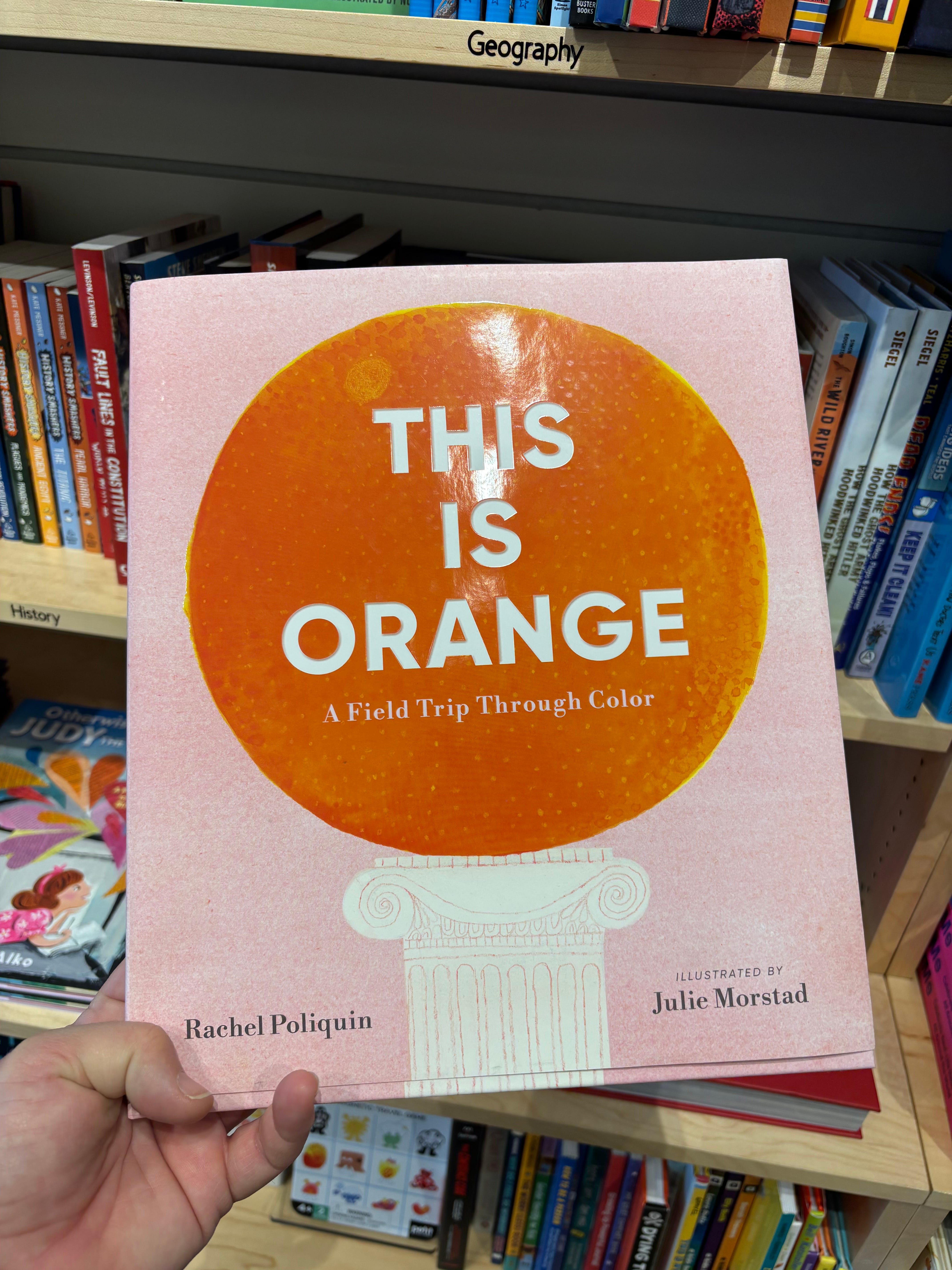
With my sabbatical, I really expected to read more. I fully planned on spending at least one full day a week lying on the couch reading a novel cover-to-cover, but found myself lazy and bogged down, and then (blessed relief) busy in the garden. Ah well. Here’s what I did read:
This is Orange: A Field Trip Through Color by Rachel Poliquin and illustrated by Julie Morstad
Ok, I haven’t made a habit of listing picture books in these logs, but I really loved this one, and have to tell people about it. I hope she makes one about every color! Engagingly written, Poliquin literally takes us around the world tracing the color orange. She talks about language and its different ceremonial uses (Buddhist monk’s robes; marigolds for Día de Muertos), different moments in art where Orange became important. The reviews are winning and I highly recommend it.
August Folly by Angela Thirkell
I’m reading the Thirkell books aloud to Mom in the evenings1 but I’m trying to go back to my favorites and listen to them, because as deeply enjoyable as reading aloud is, I sometimes miss the finer points of the narrative. Wanda McFadden does the audio and she is just perfect; like Mrs. Thirkell reading to us herself. What I love about this volume is that as she’s building the world of early 20th Century Barchester, she allows us to totally see the faults and foibles of these little villages and their people, but also, makes us love them. For example in this one we meet Lucasta Bond, and are kind of set against her, because one of our protagonists (Mrs. Palmer) is angry with her. We don’t entirely trust Mrs. Palmer — she’s fussy and demanding and a terrible housekeeper — yet we believe her intrinsically, because Thirkell has made us love her. Then 3 or 4 volumes later we meet Lucasta Bond in her own home and learn to cherish her in a whole new light. Marvelously complex world. Highly recommend.
Meet the Austins by Madeline L’Engle
I don’t know how I missed these stories, but I never read them! I devoured the Wrinkle in Time series, as well as the Starfish one (I have such a distinct memory of the school library cover of Arm of the Starfish.) but these must not have been in the library, because I was a completist even in childhood. Anyway, I loved the voice of Lily, and the funny and odd family vignettes that make up this volume. There are five total, but only 3 at my library.
Four Gardens by Margery Sharp
Perhaps my favorite of the Sharp novels for adults (though none of them, so far, compare with The Rescuers, which I loved beyond telling as a kid!) This traces the life of a woman through the four gardens she tended, and is likewise, tenderly told. She is a quiet but resourceful woman, with the love of a good man, and two charming children who, as they grow into adults, become utterly baffling to her. A small, quiet story, but well told.
The Unselected Journals of Emma M. Lion (vols. 6-8) by Beth Brower
I’m still devouring these. I am also still undecided about whether they’re good (like actually good) or just fun (which is ok! I love fun books!). Funnily enough, I have never been much for the brooding type (Rochester, Heathcliff, even Darcy at times…) but Pierce makes me utterly swoon. I was dreaming of dark stormy men for weeks. Whatever mysteries Beth Brower is weaving around Hawkes — well that’s what keeps me thinking there’s more to these novels than just fluff. I hope they shape up.2 There are definitely some inaccuracies that make me go mad (setting out for a picnic dinner in the north of England at 6pm and it’s “getting dark”?!?!) — but I think on the whole they are a blast. You are not reading these for accuracy. I think of 1885 St Crispian’s London as a totally different universe than the real 1880s London.
Gilead by Marilynne Robinson
I’ve read the whole Gilead series before, and thought I would like to re-read them. This time I listened to in on audiobook, while gardening, and on a few restless nights. I did not like the narrator, he had too self-important a voice. I thought the novel was transcendent the first time I read it (oh, 15 years ago), but didn’t really enjoy it this time. Here’s my problem: when I first read it, the other novels had not yet been published, so I didn’t know the whole story. It seemed a true account of the struggle of a man with his conscience, and facing the reality of death, of which he is not afraid, when he suddenly has so much to live for. Raw and honest and alive.
I similarly devoured the two sequels, Home and Lila, though didn’t love them quite as much. Home and Gilead revolve around the same time period, but tell the story from two separate perspectives. Lila is outside that time frame, but gives us an alternative look at the question of providence and grace.
It seemed like that was the end of the trilogy, and they were good companions, the three novels, and in fact that’s what everyone thought. I went on a deep dive of old reviews of these novels, and all the reviews talk about these three as a trilogy, which makes me think Robinson did not plan to write the 4th novel, Jack.
Now that I have re-read Gilead, I wish she hadn’t written Jack. The central moral question of Gilead and Home is one of predestination, free will, and grace. Are there individuals who are naturally bad, naturally troublemakers, naturally low, mean, petty, antagonistic? Naturally unbelievers? And if there are, is there room in God’s mercy to forgive them when they try to walk a right path? And if there that mercy, is there enough of God’s grace to allow one (a person of faith) to truly forgive, and therefore to see through all one’s own prejudices into the heart of someone lost and hurting but trying to be good, and to be humbled by it.
I said that badly, but don’t know how to put it. Let’s try a more personal angle: a friend of mine is a deeply thoughtful, truth seeking man, but has no faith. The other day, we were talking about confession (he knows I am Catholic, he was raised Catholic), and he said “well, besides the fact that I swear a lot, I don’t think I would have much to confess. I try to be a good person.” This is very true. He is a good person, and he holds himself to a high standard. I also thought to myself: what about your anger? This is also true; his impulsive reaction is often frustration and impatience bordering on anger. And then I thought to myself: what about my anger? Then I knew I was the worse sinner. This is what I mean with Jack and Rev Ames and God’s mercy. Jack spent his childhood up to no good, and much of his adulthood as a drunk; he thinks he is naturally a bad person. And Ames doesn’t have any patience for Jack, because a lifetime of trickery taught him to be impatient and untrustful. But when faced with Jack’s actual adult problem, which is not one of moral failure, but rather how to act in an unjust world,3 Ames realizes his own failure in love, and he is humbled. When Ames blessed Jack, I think Ames is the one who is truly blessed. It’s a stunning moment. Even with this poor narrator, I wept.
But then the novel Jack came along, and to my mind subverted the delicate balance of the word she had put forth. We know why Jack is an outcast socially and down on his heels by the end of Gilead. By giving voice to Jack’s side of the story it almost negates the guilt that weighs on his conscience as told in the pervious 3 novels. His fear in Jack is that he brings misery to everything he touches. But his fear in Gilead is that he is not a good man, yet he has found something to love and he wants to be good for. He’s afraid he cannot do it. That’s a very different fear. In fact it’s the fear of every Christian: we fall in love (with God, as Fr Arupe says) and it changes everything. Are we up to the task? This fear is more compelling and more pressing than the worry that everything one touches turns sour. That’s what I mean when I say that Jack robs Gilead of its power.
I’m sorry for this long discourse, especially since I actually only read Gilead this month, and didn’t re-read the others. But this question has sat with me since I read Jack when it was first published 2020, and re-reading Gilead again brought it into focus. I say none of this to discredit the novels as novels. They are well written and worth your time, if you are interested in them. But I struggle with them as a set of 4.
Love, Nina by Nina Stibbe
I mentioned this in my dairy a couple weeks ago, but this was the best thing I read all month — a total delight through and through. I literally went and bought two more copies to give to friends4. Nina Stibbe was a 20-year-old nanny for a literary family (MK, editor of London Review of Books; her 2 bright young sons; Alan Bennet as a neighbor and frequent dinner guest, etc), who missed her sister, so wrote chatty, newsy letters about her day-to-day life in London. They are so delightful. I got this recommendation from Slightly Foxed, which, if you like reading and reading about reading and quirky books, is a subscription you should get for yourself asap.
Anyway, Love, Nina is absolutely charming and unputdownable. It’s hard to pull a quote from it, because you have to get into it to know the characters, but also I grabbed one of my three copies and started looking for a quote and ended up reading it again for 20 minutes. So, you see what I mean.
Mailman: My Wild Ride Delivering the Mail in Appalachia and Finally Finding Home by Stephen Starring Grant
The Bookshop by Evan Friss
I sort of put these two in the same category; non-fiction, deeply personal, about things I’m really interested in, but ultimately, not great books. Mailman was fascinating: Grant, desperate for health insurance after being laid off from a big corporate job at the start of Covid lockdown, trains to become a rural mail carrier in his hometown of Blacksburg, VA. He talks about all the ins-and-outs of mail carrying, and has a fine candid voice, draws the characters of his fellow mail carriers well, and drifts into politics only when it’s really necessary. I think if it didn’t have the subtitle I would have liked the book better. Not that the personal parts of the story were distracting; they weren’t. But there wasn’t a general narrative of “finding home.” I listened on audio book. I have always loved my mail carriers, but I have so much more respect for them now.
The Bookshop is comprised of 10 profiles of “important” book stores in America, punctuated by short vignettes about the characters in the bookselling world (the customer who doesn’t buy anything; the cat). All the profiles were good and engagingly written, but the book itself lacked a cohesive argument. Looking at the table of contents, one can see where the book is headed. It’s vaguely chronological, and it is clearly written by a true book lover and bookstore lover, but why spend 3 chapters on bookstores with agendas. First there’s a chapter about a fascist bookstore in LA in the 30s. In the middle of that chapter, he takes a long tangent to talk about communist bookstores throughout the country; clearly disliking the former but liking the latter. Look, I would put the fascist bookstore out of business using almost any means possible, too, but why is propaganda ok when it’s one stripe and not ok when it’s another? The chapter doesn’t parse out that distinction well. Then he dedicates two more chapters to bookstores with strong agendas that were ahead of their time: a gay book store that became a refuge for people across the country and a black-owned bookstore in the heart of DC during the race riots of the 1960s. I think he wants to argue that a bookstore can and maybe even should be more than a place that sells books, because it is always and fundamentally a place of community. But his ideas aren’t clear enough. Two of the last three chapters are “Barnes & Noble” and “Amazon” and are obviously about the disruption to the market. The book overall makes a case for independent bookstores, but in a way that’s basically preaching to the choir. It could have been a lot more.
The Letters of Jane Austen read by Fiona Shaw
This was a library audio book and had literally no editorial information, so I don’t know if these are all the letters we have still in existence from Jane to Cassandra, or just some or really anything about them, but it was utterly delightful to listen to Fiona Shaw read them and Jane Austen was a lot sharper in her letters than she ever let her novels be. A total joy.
Murder Takes a Vacation by Laura Lipman
Oh guys. Books like this make me never want to read contemporary fiction again. I am pretty picky about modern mystery novels because I can’t handle the super graphic / dark ones, and the more “cozy” ones are often pretty banal. This one got some decent reviews, so I thought I would try it. But what’s the point of reading a mystery novel when the author does not respect the reader. Matt Damon suggested recently that Netflix is asking filmmakers to repeat key plot points several times in their movies because viewers often watch while on their phones. (Netflix denies this.) I kept thinking about that discussion as I was reading this book. It repeated itself so many times. Often verbatim. It didn’t draw characters, or show us who they were through actions. It just told us about them. And then it told us about them again. I had to stop halfway through. So so bad. And frankly, an uninteresting mystery.
The Borrowers by Mary Norton
Another in my project to re-read children’s books that I read as a kid but had forgotten entirely. It’s fine; it’s fun and a little silly. I think if your kid really likes a particular kind of fantasy — where we’re in our own real world, but something is different — they’d like this book. Or if they really love domestic things. It is a little difficult because I think it’s really meant for 1st graders, but a lot of first graders don’t read chapter books yet. Anyway, worth revisiting; nothing objectionable in it, enjoyable, but it won’t become a favorite and I won’t bother re-reading the others in the series, but I’m sure they’re all solid.
I haven’t been including them in these roundups because I want to do a longer piece about them. We just finished Vol 9, Before Lunch.
I am unsure whether she will fulfill this promise though. Islingotn tells Emma that she will see a different side of Hawkes while they’re at Stonecrop; that the guard will come down and she’ll see an intimacy there that she won’t see when they’re back in London. But as it played out, he was exactly as elusive as before, just in shirt sleeves.
SPOILER: he is in a biracial marriage, in 1956, in St Louis, and has a son. He is not married in the eyes of the law (it’s still illegal) though he definitely thinks of himself as married (common law) That marriage is frowned upon by her own family, and the wider world of course punishes him for it. His own family does not know and he’s trying to decide whether to tell them and bring is wife and son back to his childhood home.
one, for someone in particular; the other just to have in case!
You’ll have to let me know what you think about the other books in the Austin series. I loved Meet the Austins and A Ring of Endless Light, but the others were either too far fetched in terms of plot or too plodding (I couldn’t even finish A House Like a Lotus) to really enjoy. I wish she had stuck with the Vicky-comes-of-age theme and not tried to go off into sci-fi murder mystery territory. And I absolutely loathe the character of Zachery Gray, who appears in a couple of the later books. I hated him in An Acceptable Time, too, but I enjoyed the rest of that book enough to overlook how awful he is.
Have you read the Angela Marchmont or Freddy Pilkington-Soames mysteries by Clara Benson? I feel the same as you do about contemporary detective fiction. The author first published these under a pseudonym to see if she could pass off the book as “an undiscovered Golden Age mystery” found in an attic- and she did! They are delightful. Not too serious, not too fluffy, lots of tootling about London etc.